For Part 147 schools

Let students meet the oral format before exam day.

Give your Part 147 students a place to answer real oral questions out loud, work through an AI examiner's follow-up questions, and leave with a report tied to FAA handbook pages. You follow their practice in a class view.

A free pilot for Part 147 programs: one class, 4–6 weeks. No school IT setup, nothing to grade, and you can try it yourself before any student joins.

Want to try it in class first? Run a 5-minute oral warm-up today: one question on the projector, no accounts.

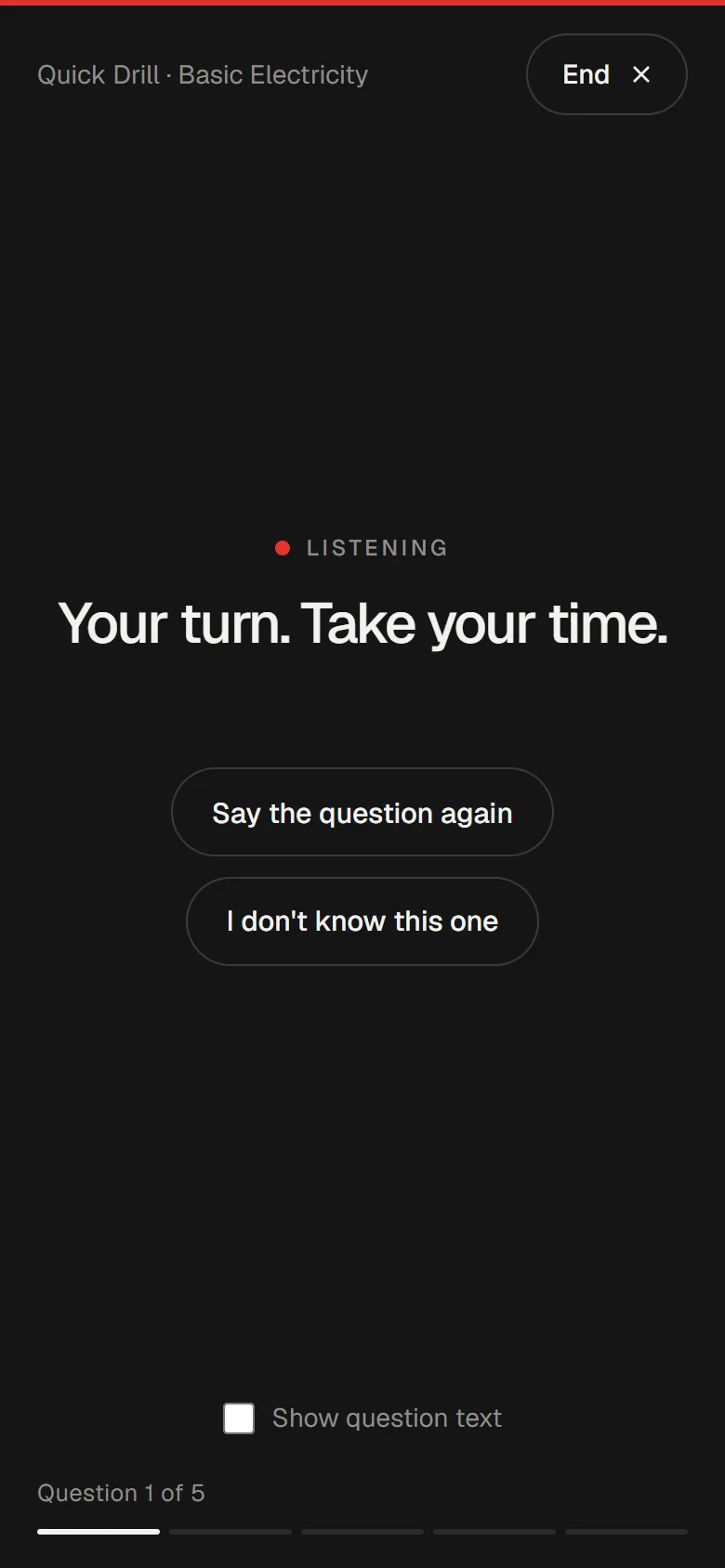
App screen during a Quick Drill on Basic Electricity: a red Recording dot and the words Your turn. Take your time., with buttons Say the question again and I don't know this one.
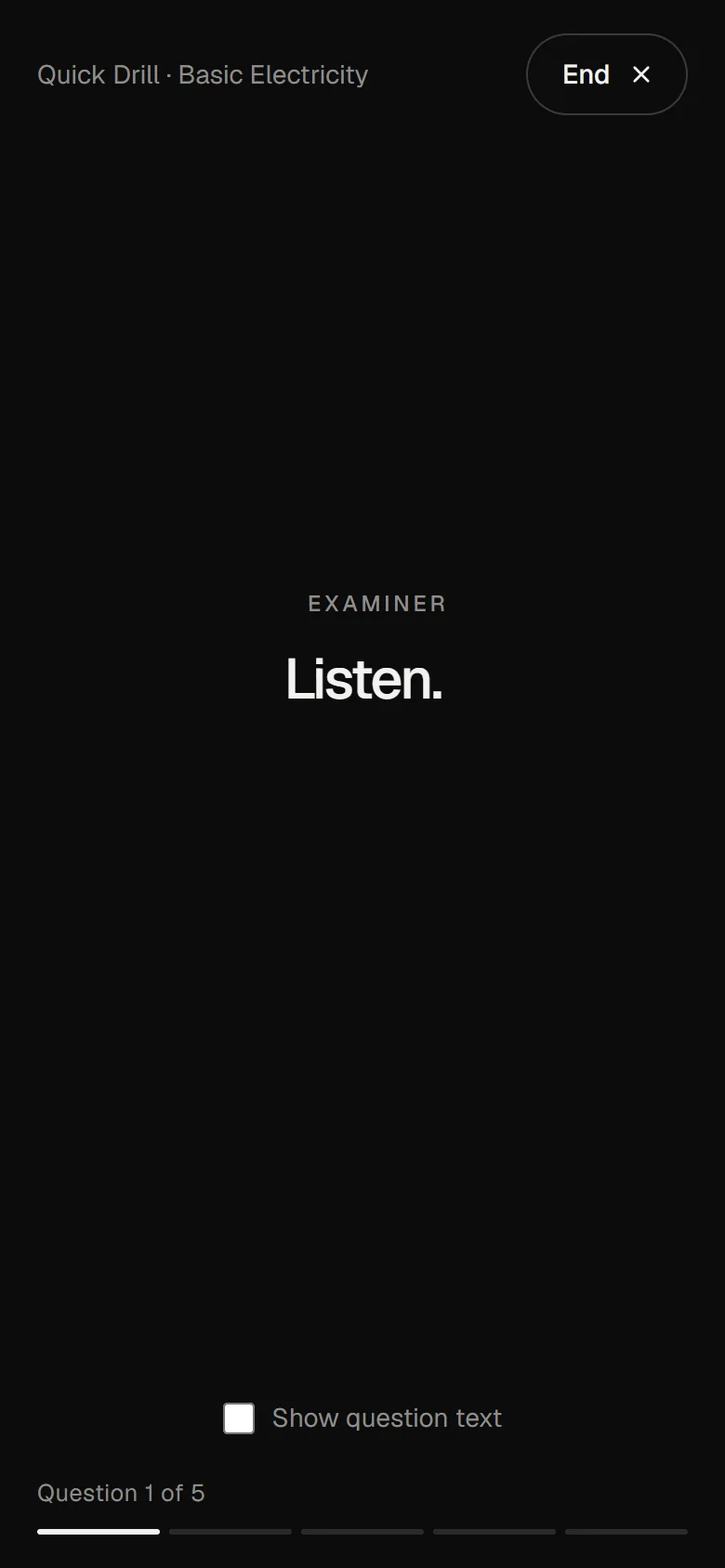
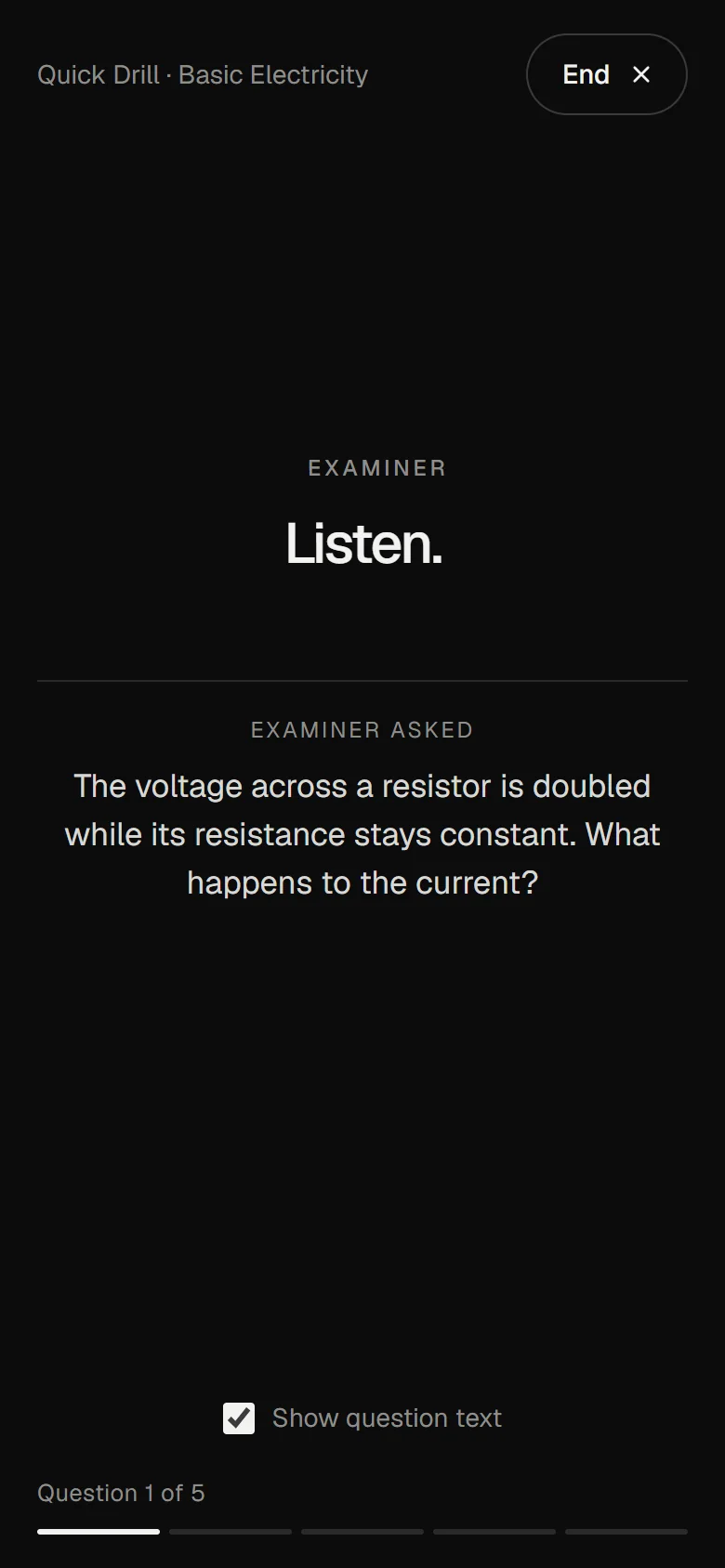
Real screens from the DMEReady app's live session, Question 1 of 5 in a Quick Drill on Basic Electricity.

Follow-ups like a real DME. Student audio isn't stored.

Sample session · AI candidate voice; DMEReady's AI examiner, questions and report.

Pilot at a glance

  • One class, up to 30 studentsWe agree the size and dates with your school first.
  • 4–6 weeksBefore their oral, or alongside the subjects they are taking.
  • No IT or learning-system setupStudents practice on their own phone or computer; nothing to install.
  • Nothing to gradePractice feedback, not an assessment. Open the class view when you like.
  • Try it yourself firstYour instructor account comes with a sample class and full practice in every section.
  • About 10 minutes to set upRequest an account, create a class, share its 8-character code. Free for your school and your students.

A place to practice saying what they know.

Your program teaches the knowledge and the hands-on work. DMEReady gives students more chances to talk that knowledge through out loud: at the end of each subject block, not only in the weeks before the oral.

Oral rehearsal only. It complements your instruction and practical training.

Answers spoken, then questioned
The AI examiner listens and follows up on a student's answer. Students practice explaining a system, rather than recognizing an answer on a screen.
Feedback with a page to study
Every report point ties to a source page. The question bank is built on public FAA material: the FAA-H-8083 handbook series, ACS, and AC 43.13.
Organized by the ACS subjects you teach
Part 147 curricula are designed to align with the mechanic ACS (14 CFR 147.17). DMEReady's questions are grouped by the same ACS subjects, so a class can drill the subject it just finished.
Practice from their written-test codes
Students can type the ACS codes on their Airman Knowledge Test Report and rehearse those areas. DMEReady does not connect to their FAA testing record.
A class view for instructors
See who has practiced, how each student's answers came out (met, partly met, missed), which topics the most students need to revisit, and each student's reports. It only shows students who joined your class and agreed to share. See the instructor view.

What you see as an instructor.

The Class tab in the app, shown with the sample class that every instructor account includes. The students are fictional; their reports come from DMEReady's real scoring.

Sample Aviation Maintenance School

Sample class Sample data

Fictional students. Follow practice, offer support.

This week

In the sample class, from practice shared with you.

  • 6 of 6 students who tried Weight and Balance have answers to revisit — most often on “Weight and balance terminology”.
  • Weight and Balance: 6 of 7 done, due in 2 days.
  • 3 students entered an oral date in the next 14 days; 1 of them hasn't practiced in the last 7 days.
  • 1 student joined but hasn't practiced yet.
  • 6 of 7 students practiced in the last 7 days (the 7 days before: 4).

Practice feedback, not a grade. AI scoring can misjudge a spoken answer. Check with the student before acting on a result, and don't use it for grades, graduation or sign-off.

7students joined
6answered a question in the last 7 days
37practice sessions in total

FAA elements, student by student

Weight and Balance · each mark is one student on one ACS element, from their latest scored answers. In the app, tap a mark to read the answer.

Weight and Balance: ACS elements by student in the sample class (5 of 11 elements shown)
ACS elementASAvery SampleJSJordan SampleMSMorgan SampleCSCasey SampleRSRiley SampleTSTaylor SampleDSDrew SampleClass
AM.I.C.K1Weight and balance terminology.3 questions in the bank1 met · 4 to revisit
AM.I.C.K2Purpose for weighing an aircraft.1 question in the bank2 met
AM.I.C.K5Purpose and application of weight and CG limits.2 questions in the bank1 met · 3 to revisit
AM.I.C.K6Purpose of determining CG.1 question in the bank1 met · 1 to revisit
AM.I.C.K7Adverse loading considerations and how to calculate if adverse loading causes an out-of-limit condition.1 question in the bank3 met · 2 to revisit

Based on the questions answered; one answer is not mastery. Skill (S) elements are performed on the practical and aren't part of the oral.

The sample class in the instructor view (Weight and Balance, 5 of 11 elements shown). "This week" is built from the class's own practice. Tap a mark to see the question, the student's answer, the points they missed and the FAA handbook page; from there you can assign another practice to the students who need it.

You can see

  • Each student's name, email and oral exam date, if they entered one.
  • A short "This week" list of plain facts to act on: the topic the class should go over, assignment progress, oral dates within 14 days, who hasn't started.
  • For each topic, the FAA elements student by student. Tap a mark to read the answer, the missed points and the FAA handbook page.
  • Sessions, last practice, and how their answers came out: met, partly met or missed.
  • Every report, exactly as the student sees it. You can add an agree or disagree note the student sees; the AI result stays unchanged.

By design, you don't see

  • Pass predictions, readiness scores or rankings. Students are not compared with each other.
  • A grade. Results are practice feedback; AI scoring can misjudge a spoken answer, so they aren't meant for grades or sign-off.
  • A student's private study list or payment details.
  • Anyone who hasn't joined your class.

You can set assignments (a topic, the elements to include, which students, 3 or 5 questions and a due date; students see them on their home screen and get one reminder) and, after reviewing the answers, assign another practice to the selected students. You can mark any result "agree" or "disagree" with a note the student sees, download a CSV practice summary (not grades), see Full Oral practice by section, and get a short Monday email with class totals. You can run several classes, pause joining, issue a new code, and remove a student. Your instructor account also includes practice access, so you can try every drill as a student would.

Sample report · after the demo exchange

From a spoken answer to a page worth revisiting.

Each report shows how many answers met practice criteria, which ones were missed or only partly answered (weakest first), and what to work on next. For every question: what the student said, what they covered, a follow-up a DME might ask, and the FAA handbook page to study. You see the student's AI report. Add an agree/disagree note; the original result stays unchanged.

Question 1 shows an actual scoring result; the other results and coaching lines are illustrative.

Practice report

Quick drill · Basic Electricity

5 questions · 7 min

3of 5 met

2 to work on

Practice these 2 again

Same questions again, out loud. This report stays as it is.

What to work on

You went quiet for about 9s before one answer. Say the part you're sure of first; the examiner expects a pause, not a freeze.

3 answers opened with 'I think' or 'maybe'. State it plainly; hedge only when you really aren't sure.

Your answersWeakest first

Basic Electricity

Question 4: What happens to the wiring when current flow in a circuit exceeds normal?

Missed
Basic Electricity

Question 2: How do you determine the total resistance of a DC circuit?

Partly
Basic Electricity

Question 1: How are current, voltage, and resistance related in an electrical circuit?

Met
You said

“Um, okay. So voltage is, like, what pushes the current, and resistance kind of works against it. The more resistance you've got, the less current you get. That's Ohm's law, I think.” … “If the resistance stays the same, the current doubles too. Yeah. It doubles. So they're, um, directly proportional. It's a straight line.”

What you got
  • In most cases, the greater the circuit resistance, the less the current
  • This relation is linear in nature and is known as Ohm’s Law

FAA-H-8083-30B, p. 12-17, 12-18

Basic Electricity

Question 3: Walk me through how power is defined and measured in an electrical circuit.

Met
Basic Electricity

Question 5: What makes a material a conductor, an insulator, or a semiconductor?

Met

600+ oral questions, 2,300+ follow-ups — all from FAA handbook pages, and growing

Sample report. Question 1 is the demo exchange above, as DMEReady's scoring returned it; the results for questions 2 to 5 and the “What to work on” lines are examples of what the report shows. Questions, critical points and references come from our question bank, built on public FAA material (ACS, FAA-H-8083 handbooks, AC 43.13). DMEReady is an independent study tool and is not affiliated with the FAA.

How the pilot works.

We agree the class size and dates with your school before students start.

A typical pilot: one class of up to 30 students for 4–6 weeks, either before their oral or alongside the subjects they are taking. It is free for your school and for the students in the pilot class: students get free access as soon as they join. Students practice on their own time, in a quiet spot: a Quick Drill is 5 questions and up to 8 minutes, a Unit Oral 10 questions and up to 18 minutes. There is nothing for you to grade; open the class view when you like.

  1. Request an account

    Use the form below. We set up an instructor account for your school email. Sign in at app.dmeready.com and open the Class tab; the sample class is already there, and you can start a practice yourself from the same screen.

  2. Create a class, share the code

    Name your class and share its 8-character code or invite link by email, in your learning system, or on the board.

  3. Students join with consent

    Each student signs in, opens the link or enters the code under Account → Class, sees exactly what you will see, and ticks a box to agree. They can leave at any time.

  4. Follow practice, tell us what helped

    Open the class view whenever you like. At the end of the pilot we review it with you and ask what helped and what your students still need.

Suggested starting plan

  • One 5-question drill per student each week.
  • About 10 minutes of instructor review a week, in the class view.
  • A short feedback chat with us at the end.

What we look at together

  • Participation: who practiced, how often.
  • Findings you could teach from: the topics the class kept missing.
  • Results you disagreed with, so we can check the scoring.

A suggestion to start from, not a requirement or a measured time; the pilot is not an exam prediction.

Your instructor account includes 180 days of practice access (the sample class plus your own practice). The student pilot is a separate 4–6-week window; its end date does not by itself remove your class view. Students can leave your class at any time, which ends that access.

Student privacy, in plain terms.

Students decide. Nothing is shared with an instructor until a student joins a class and agrees on the consent screen in the app.

Data at a glance

  • Consent required
  • No audio stored
  • No school-system connection
  • Students can leave anytime
  • Not for grades

Students can leave a class at any time, which ends your access, including past reports. We don't sell student information or share it with the FAA, an employer, or anyone else at the school. Students keep their reports while their account is open and can ask us to delete them.

Sending this to your IT? Read the 2-minute school privacy and pilot terms: retention, security, FERPA, and what happens when a pilot ends. The full text is in the privacy policy, under "Sharing with your instructor".

When a student joins your class, you can see

  • their name and email address
  • their oral exam date, if they enter one
  • their practice sessions and reports (the same reports they see) from the day they join; earlier practice only if they tick a separate box
  • their progress by section and topic, and the questions marked "to review"

This is the list each student reads before ticking "I agree" in the app.

One class. A free 4–6-week pilot.

The pilot is free for your school, including the instructor view and practice access for the students in your pilot class. No automatic charges. We agree any paid continuation with your school first; after the pilot, schools get discounted group pricing.

Request a free instructor account

Request a free instructor account.

Tell us about your program. A person reads every request and replies by email, usually within a day, to set up your account or a short call.

DMEReady is built by Serdar, an independent founder, and operated by Smart Hub LLC. Questions and critical points are mapped to public FAA handbooks (FAA-H-8083-30B, 31B and 32B, the ACS, and AC 43.13-1B/2C) and checked against the source text before they go live. Not affiliated with or approved by the FAA. Requests come straight to me.

Just have a question? Use the same form, or email hello@dmeready.com.

Email hello@dmeready.com with your school, your role, about how many students, and when they expect the oral.

Before you bring it to class.

A few things instructors ask.

Does it replace instructors, the DME, or our own assessment?

No. DMEReady is a place to practice speaking. It supports your teaching and your assessment; you teach and you make the call. It does not replace a DME, the oral, or the practical exam.

Is DMEReady affiliated with or approved by the FAA?

No. DMEReady is an independent study tool, not affiliated with, authorized by, or endorsed by the FAA. It uses public FAA source material, does not count toward any FAA requirement, and does not guarantee a pass.

How accurate are the questions and reports?

Questions and critical points come from our question bank, built on public FAA material: the FAA-H-8083 handbook series, the ACS, and AC 43.13. Every report point shows its source page, so you or a student can check it. The AI examiner can misjudge an answer, so treat a report as practice feedback, not a grade. If something looks wrong, email us and we'll check it against the source.

What does it cover?

Oral questions for General, Airframe and Powerplant, organized by ACS area. Students can also type the ACS codes from their Airman Knowledge Test Report and practice those areas. DMEReady does not connect to their FAA testing record. The coverage page lists, subject by subject, which ACS knowledge and risk management elements have a practice question today.

What happens to student data and audio?

We don't store session audio. Spoken answers are turned into text, and we keep that text and the report so the student can review them later. Instructors see a student's practice only after the student joins their class and agrees. See student privacy above and the full privacy policy.

Do you sign student-data agreements (for example, under FERPA)?

We don't have a standard school data agreement yet. In the pilot, students create their own accounts and choose to share with you; we don't receive records from your school. If your school has its own data agreement, send it with your request and we'll review it with you before any student joins. See school privacy and pilot terms.

What devices do students need?

A phone or computer with a web browser; there is nothing to install. Students need internet access and microphone permission. Headphones and a quiet spot help them hear the examiner and be heard clearly.

What does it cost?

The pilot is free for your school, including the instructor view and practice access for the students in your pilot class. After the pilot, ask us about discounted group pricing for schools. Nothing is charged without your agreement.

How many students can join, and how fast can we start?

A typical pilot is one class of up to 30 students for 4–6 weeks before their oral. Tell us your expected student count and timing when you request an account; we'll agree the class size and pilot dates with you. Once your instructor account is set up, you can create a class and share its code the same day.

Try it with your next group.

Tell us about your program. We'll set up your instructor account, work out a pilot together, and ask for your feedback.

Request a free instructor account